

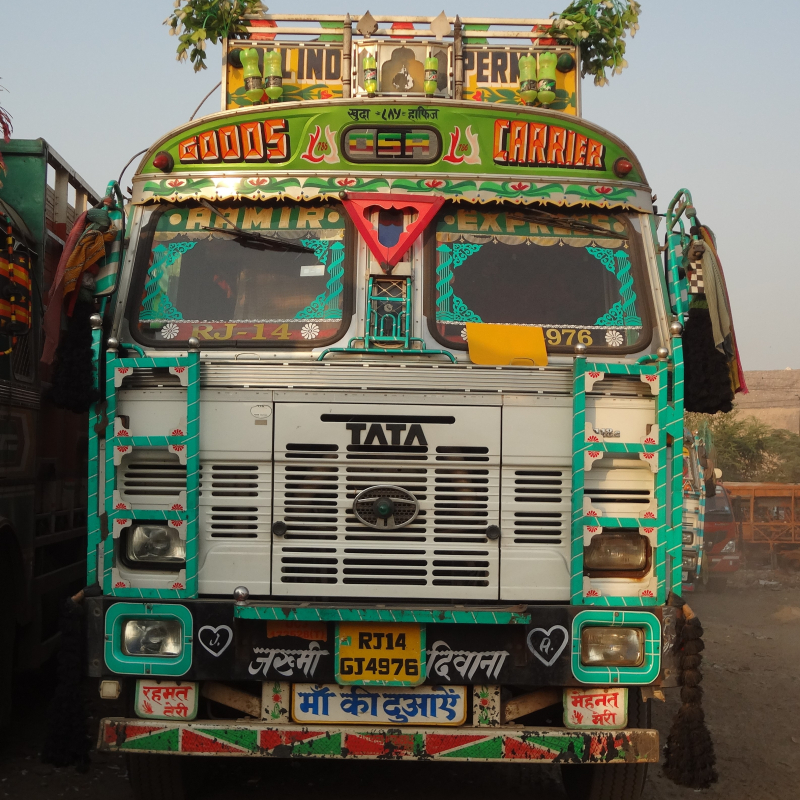
Vijay Kumar Yadav, a 40-year-old truck driver from Sant Kabir Nagar in Uttar Pradesh, often hums a couplet while on the road. For him, it captures the quiet truth of his life: a driver, he says, has no real home beyond the truck he steers.
Across his two decades behind the wheel, Yadav has never had such couplets—locally known as shayaris—painted onto his own truck. In fact, he worries they might do more harm than good. A distracted driver reading poetry on his vehicle, he explains, could easily drift off course or collide with him. For that reason, he prefers simplicity over ornamentation. Still, these verses stay with him, carried in memory and softly recited across long journeys.
Having driven extensively across India and Nepal, Yadav is deeply familiar with the poetic lines that decorate truck bonnets and bumpers. In North Delhi’s Transport Nagar, as he walks alongside me while I document these inscriptions, he begins recalling some of his favorites from the road:
‘कम पियो मेरी रानी/ बहुत महंगा है इराक का पानी’ (Drink less, my dear / Iraqi water is too expensive), and
‘सजी हुँ, सँवरी हुँ, नजर मत लगाना/ जिन्दगी भर साथ दुँगी, पी कर मत चलाना’ (I’m all dressed up, don’t cast an evil eye / I’ll stay with you for life, but don’t drink and drive).
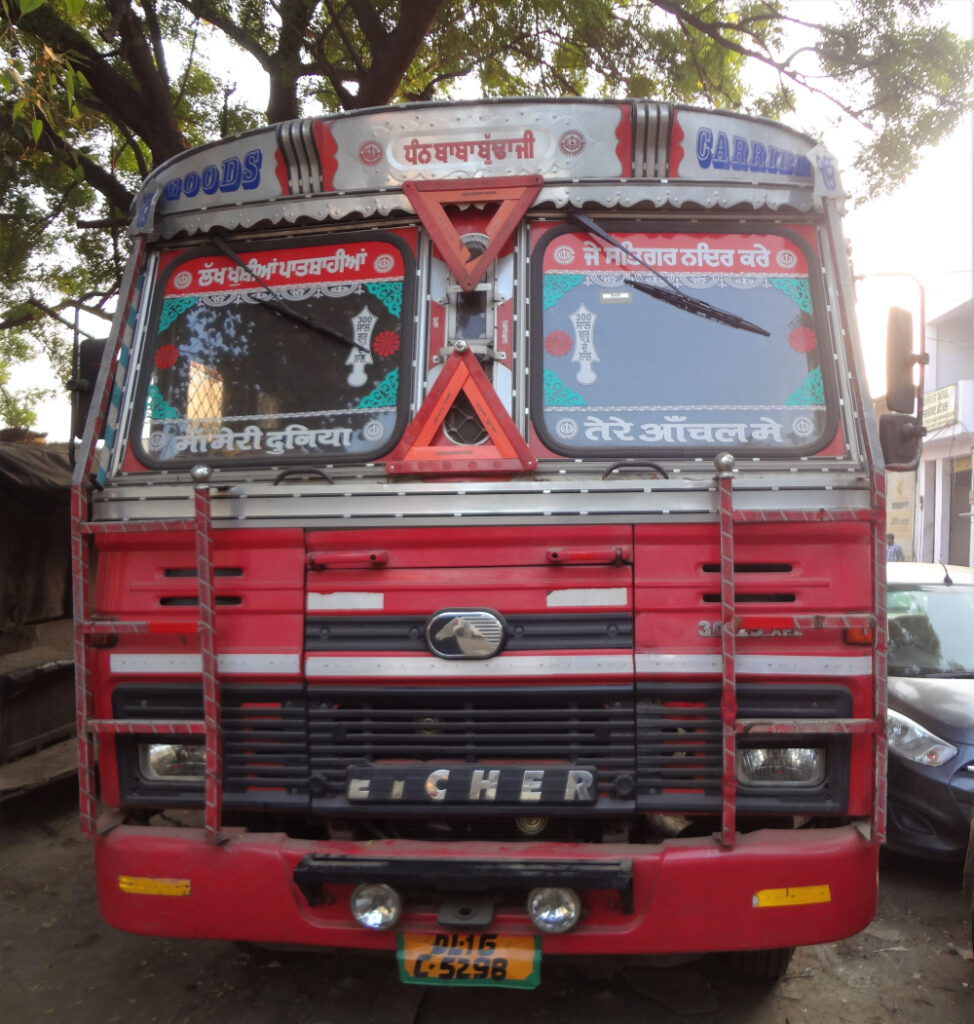
Truck art is a defining thread of popular visual culture across South Asia. It transforms vehicles into moving canvases using paint, stickers, woodwork, and metal embellishments, giving each truck a distinct identity. These designs often include portraits, floral patterns, intricate calligraphy, and even structural extensions that reshape the truck’s body itself. Depending on who holds creative control—the driver, owner, or painter—each truck becomes a personal statement on wheels.
Emerging in the 1940s, truck art in South Asia initially relied on limited color palettes and only occasional religious motifs. By the 1960s, however, it began absorbing influences from psychedelic pop culture, incorporating images of film stars, political leaders, and bold decorative styles. Over time, it evolved into a distinct regional language of design, with each country developing its own visual identity. Pakistani trucks became known for their vivid, heavily ornamented style; Indian trucks tended to be more restrained in color and decoration; while Nepali trucks, though visually similar to Indian ones, leaned more heavily into poetry and written expression.
In recent years, South Asian truck art has gained increasing visibility online, with dedicated social media communities and even museum-like representations. In 2019, Mumbai saw the launch of a mobile art gallery built inside a truck itself—an exhibition that brought this traveling art form into institutional space.
Within this broader tradition lies a lesser-known dimension: truck literature. This refers to the written expressions—shayaris, couplets, slogans, and one-liners—that adorn trucks and serve as a parallel form of creative storytelling. Though still underexplored in mainstream discourse, it remains a vivid reflection of the lives, values, and emotions of those connected to trucking. These inscriptions often touch on themes such as faith, identity, safety, patriotism, longing, and love. They also appear on other vehicles like pickups and autorickshaws, extending beyond trucks alone.
Changing Dynamics
Surinder Chhabra, a 60-year-old truck painter based in Delhi’s Sanjay Gandhi Transport Nagar, has spent over four decades working on these moving artworks. He has witnessed firsthand how both truck art and truck literature have evolved. He recalls the 1980s, when elephant motifs became widespread following the 1982 Asian Games and its elephant mascot. Compared to those earlier decades, he feels today’s designs are often more fragmented and less expressive: “Nowadays, drivers mostly ask for what I’d call random quatrains,” he remarks.
Yet he also acknowledges that these choices reveal something important about drivers’ identities. The combination of imagery and text often follows recognizable patterns. Delhi-based drivers, he notes, frequently request tigers and eagles as symbols of strength. Muslim drivers may prefer depictions of the Taj Mahal, while Punjabi drivers often favor imagery of a woman waiting for her lover, paired with the line “Ghar kab aaoge?” (When will you return home?). Another recurring Punjabi motif is the portrait of Bhagat Singh, the revolutionary icon of resistance.
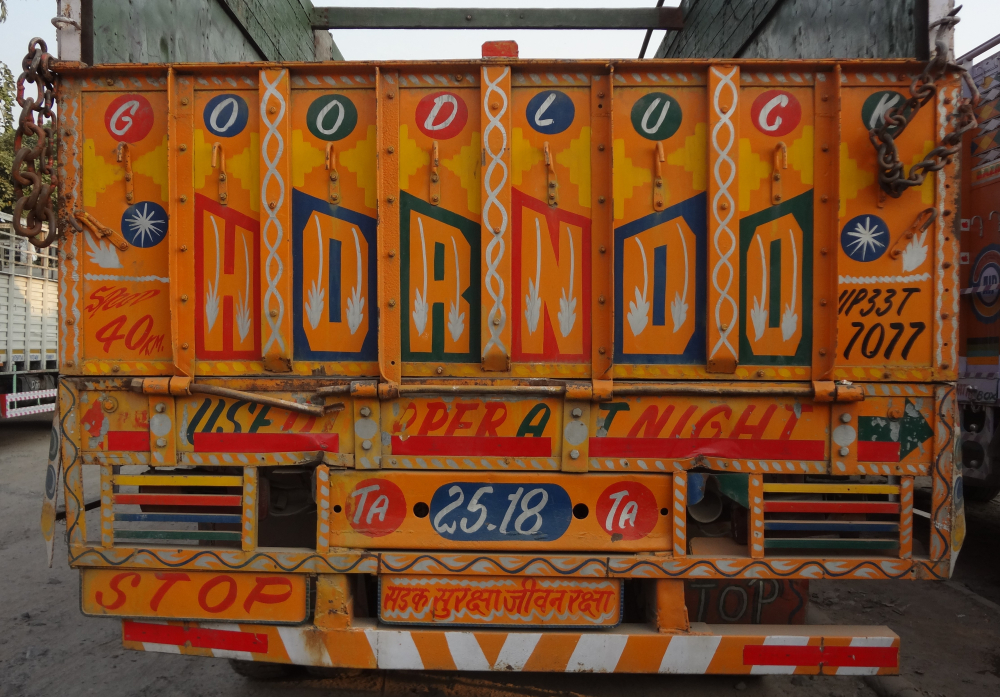
Shubham Raj, a 25-year-old truck designer in the same transport hub, adds another layer to this evolving landscape. He points out that government slogans like “Beti bachao, beti padhao” have become standard features on many North Indian trucks. In some cases, he explains, including such slogans is practically necessary to pass vehicle inspections. In Haryana, for instance, drivers are sometimes required to purchase official stickers if the slogans are not already displayed. This has even created a small informal market, where stickers are sold at different price points depending on where they are purchased.
Recurring Themes
Despite these shifts, certain themes remain remarkably consistent in truck literature across North India. Observations from more than 200 trucks across Delhi, Haryana, Punjab, Rajasthan, Uttar Pradesh, and Jammu & Kashmir reveal four dominant categories: aphorisms, identity and belief, road safety messages, and romance.
a) Popular aphorisms
A large portion of truck inscriptions consists of general life wisdom and moral sayings, often drawn from everyday philosophy. Examples include:
Beauty is only to see, not to touch
समय से पहले भाग्य से ज्यादा कभी नहीं मिलता (Nothing comes before its time or beyond fate)
कर्म ही पूजा है (Work is worship)
सोच कर सोचो, साथ क्या जाएगा (Think carefully about what truly matters)
बुरी नजर वाले तेरा मुँह काला (May ill intentions be punished)
b) Society, beliefs and identity
Many trucks display place names, religious invocations, and expressions of identity. These inscriptions help drivers anchor themselves emotionally while traveling across unfamiliar regions. Common examples include:
Jai Hind
Jai Mata Di
Jai Vaishno Devi
Swachchh Bharat
India is great
माता पिताका आशीर्वाद (Parents’ blessings)
मेहनत मेरी रेहमत तेरी (My effort, your grace)
माँ मेरी दुनिया तेरी आँचल में (My world rests in my mother’s embrace)
जन्नत ए कश्मीर (Paradise of Kashmir)
यह दिल्ली है, लन्दन से कम नहीं (Delhi is no less than London)
c) Traffic rules and road safety
Safety-related messages form another strong category, reflecting the risks inherent in long-haul driving. These are often direct, humorous, or cautionary:
Keep distance
Horn OK please
Use dipper at night
सड़क सुरक्षा, जीवन रक्षा (Road safety is life safety)
धीरे चल प्यारे, जिंदगी अनमोल है (Drive slowly, life is precious)
लटक मत बेटा पटक देगा (Don’t hang on, you might fall)
d) Romance
Perhaps the most emotionally expressive category, romantic inscriptions reflect longing, separation, and playful affection. Many emerge from the solitary nature of long-distance driving:
देखो मगर प्यार से (Look, but with love)
तुम कब आओगे (When will you return?)
दिल किसी के प्यार में बेकरार मत करना (Don’t let your heart grow restless in love)
हस मत पगली, प्यार हो जाएगा (Don’t laugh, girl, you’ll fall in love)
Truck Literature in Decline
Despite its cultural richness, truck literature is gradually fading. According to field observations at Sanjay Gandhi Transport Nagar, this decline is driven by both regulatory and technological shifts.
Policy changes have played a major role. Slogans and painted expressions are increasingly scrutinized under advertising restrictions and road safety regulations. Drivers report being warned or fined for offensive or distracting text, and in some cases, inscriptions are interpreted as unauthorized vehicle modifications under the Motor Vehicles (Amendment) Act, 2019. Rising penalties have made many drivers hesitant to commission new shayaris at all.
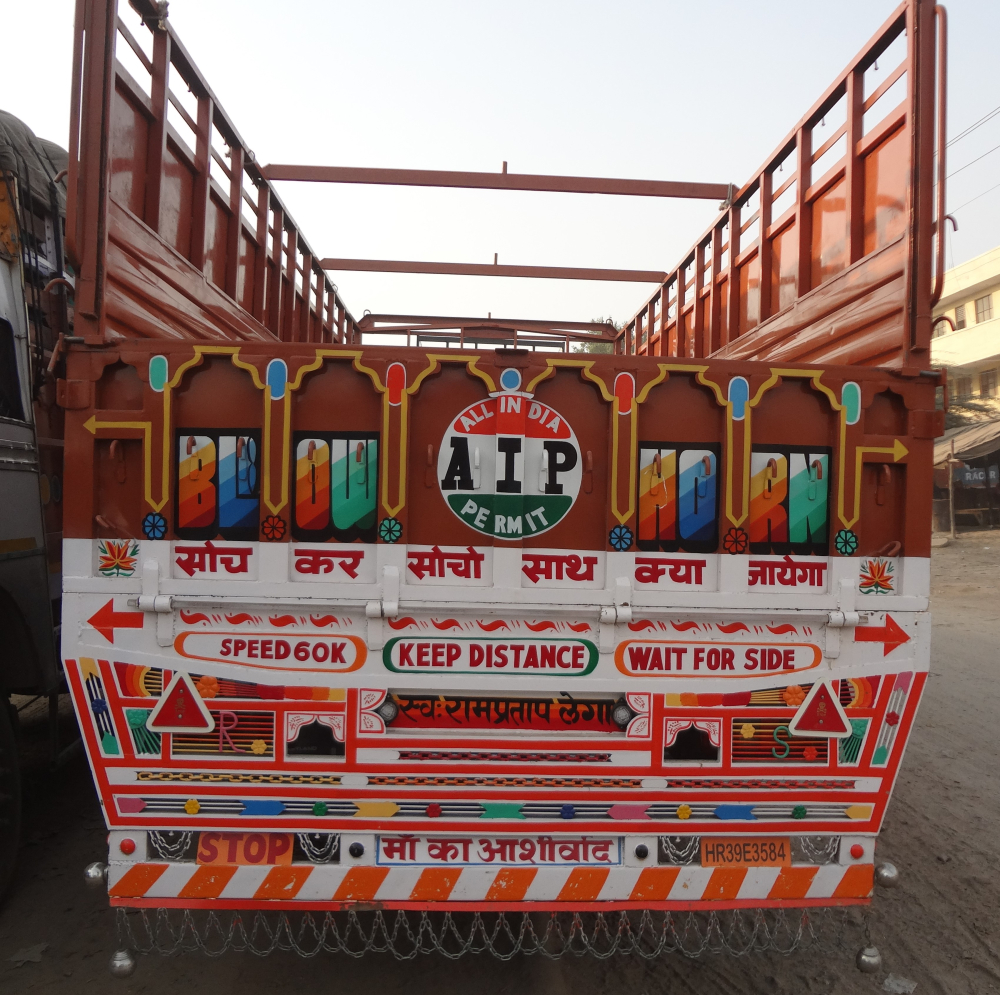
At the same time, painter Surinder Chhabra points to another force of change: technology. Traditional hand-painted designs are increasingly being replaced by radium tapes and printed stickers, which are cheaper, faster, and more reflective at night. While these materials improve visibility and reduce production time, they also reduce the physical space available for hand-painted poetry and calligraphy.
Radium sticker designer Tejinder Pal Singh notes that modern trucks often have their front panels fully covered in reflective material, including pre-printed slogans and shayaris. This shift, while practical and safety-oriented, has steadily squeezed out the traditional handwritten aesthetic that once defined truck literature.
Together, these changes—regulatory pressure, shifting aesthetics, and technological substitution—are quietly reshaping a once-vibrant form of moving expression. What remains is a culture still in motion, but with fewer words painted on its passing surfaces.