
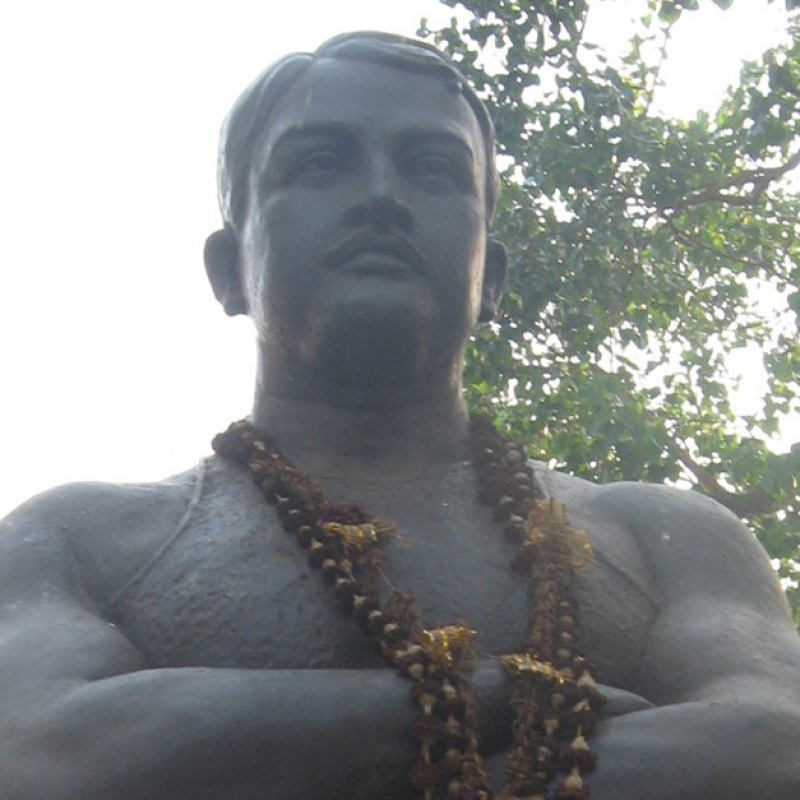
Barely 18 years old, Gobar Goho already carried a rare kind of foresight—he could imagine Indian wrestlers standing on global mats at a time when almost no one else believed it possible. Nearly half a century after his passing, we look back at the life of a man who was first placed into wrestling by family tradition, yet went on to become one of the sport’s earliest pioneers and most influential visionaries in India. (In Pic: A bust of Gobar Goho at Hedua Park, Kolkata; Photo Source: BengaliHindu/Wikimedia Commons)
It was 1909. Wrestling, once a celebrated and widely practiced art across the Indian subcontinent—especially under royal patronage—was beginning to fade alongside the decline of the princely states. Yet it was the idea of a teenager, just 18 years old, that would begin to reshape how the world viewed Indian wrestling, and how Indian wrestlers viewed themselves. More than a century later, with countless international accolades and Olympic medals to its name, Indian wrestling stands firmly on the global stage.
But who exactly was Gobar Goho, and how did this young athlete help transform the sport in India? Nearly 50 years after his death, we revisit the journey of a man who was initially steered into wrestling by family expectation, but ultimately reshaped its destiny.
Can’t Fight Destiny
Jatindra Charan Guho was born on March 13, 1892, in Kolkata, West Bengal, into a family deeply rooted in wrestling tradition. His lineage included figures like the renowned Ambu Babu, founder of an akhada (wrestling arena) on Masjidbari Street, and Khetracharan Guho, who is also known for having taught Swami Vivekananda. Following a familiar Bengali custom of affectionate nicknames, his father Ram Charan called him “Gobar” (cow dung), likely as a playful tease for his chubbiness and laziness. Over time, Jatindra became widely known as Gobar Goho, with “Goho” serving as the anglicized form of Guho.
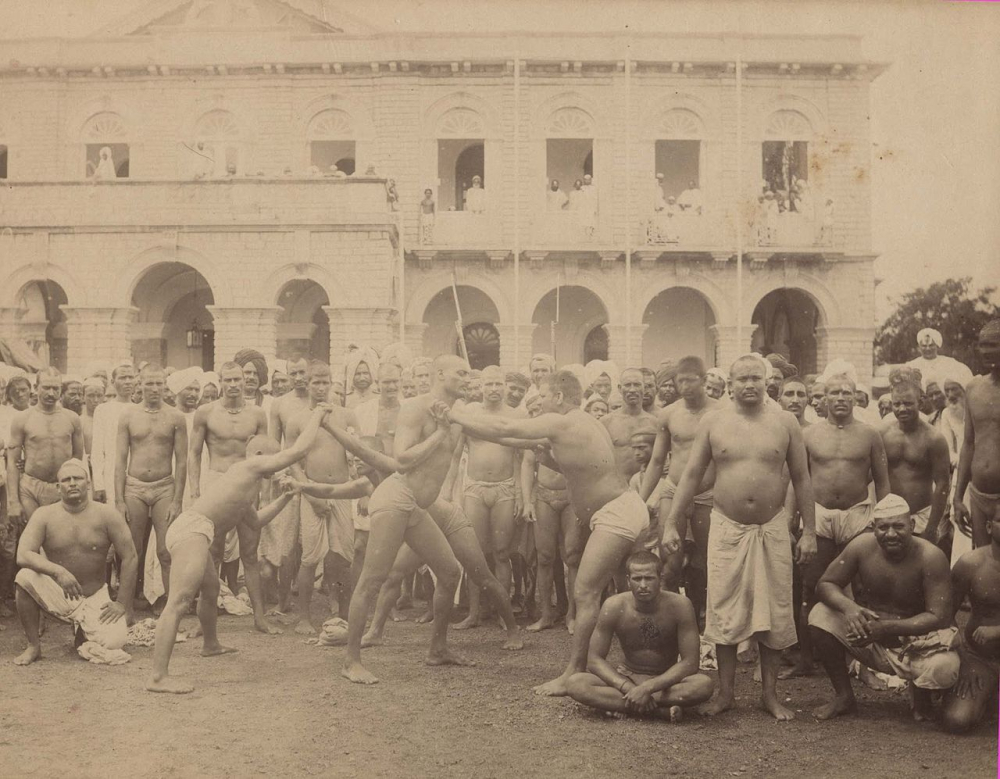
Wrestling had long been woven into the cultural fabric of the subcontinent, yet by the late 19th century, many traditional akhadas—such as the one in Hyderabad around 1870—were gradually disappearing along with the fall of princely power (Photo Source: Wikimedia Commons)
Despite being surrounded by wrestling from childhood, Goho initially showed little interest in stepping into the ring. He was instead trained in Hindustani classical music, pursuing a very different path. However, after his father’s death in 1901, the family—determined not to let their wrestling legacy fade—encouraged the physically sturdy nine-year-old to take up the sport.
He proved to be naturally gifted. By the age of 15, under the mentorship of his uncle Khetracharan, he had developed into a skilled pahalwan (wrestler). Soon after, his uncle brought in Rehman, a respected guru from Amritsar, to refine his training. But just as Goho’s professional journey was beginning to take shape in 1909, tragedy struck again with the death of his uncle—an emotional and professional setback for the young wrestler.
At the same time, Bengal was in the midst of rising revolutionary activity against British rule. Many akhadas—some originally founded by his grandfather Ambu Babu—had begun shifting roles, becoming centers for underground resistance training as well as informal strongholds of local strongmen. Goho, who valued wrestling as discipline and sport, became determined to restore its dignity and identity as a respected athletic tradition.
The Teen Visionary
1909 was a year of both loss and transformation for Goho. While personally difficult, it became the turning point that shaped not only his life but also the future of Indian wrestling. Disturbed by the declining status of the sport and its practitioners, he resolved to carry forward his family’s legacy in a meaningful way.
Fate intervened through a trip to Lahore with his brother-in-law, Sarat Kumar Mitra, a wealthy businessman with a deep appreciation for wrestling. They traveled to witness a highly anticipated clash between two legendary pahalwans: Ghulam Mohammad Baksh Butt (The Great Gama) and Rahim Sultaniwala.
These two titans had already met twice before in grueling, inconclusive battles. Their Lahore encounter was no different—a fierce, exhausting contest lasting nearly two hours, leaving spectators awestruck. For young Goho, the match sparked a powerful realization: what if wrestlers like Gama and Sultaniwala could be taken to London, the heart of the British Empire, to compete against the world’s best? It would be a statement to the world about Indian strength and skill.
Goho shared this idea with Mitra, who immediately agreed to support the vision financially. By 1910, an ambitious group set sail for England: Gama, his brother Imam Baksh, Ahmed Baksh, Gamu from their akhada, along with a cook, assistants, Mitra, and Goho himself. However, Goho’s journey was cut short—he had traveled without informing his family, and upon learning of it and his mother’s illness, he was called back to India.
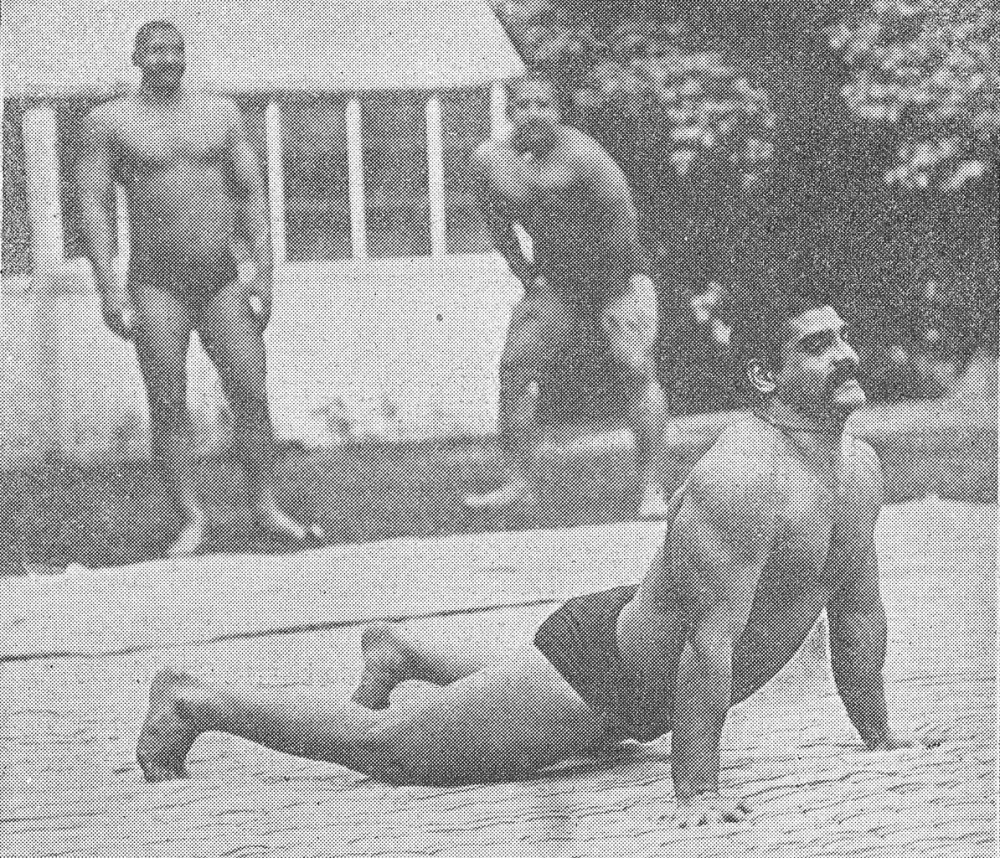
The rest of the team continued, and despite immense challenges in England, they eventually achieved historic success. While that story is often told through Gama’s legacy, the foundation of the venture is inseparable from Goho’s vision. It marked a turning point that placed Indian wrestling firmly on the global map.
One Fight at a Time
Though his early international journey ended abruptly, Goho soon went on to carve his own path across the world. In 1913, during a European tour, he defeated several prominent wrestlers, including Jimmy Campbell and Jimmy Essen. But one of his most legendary victories came in 1921, when he faced American light heavyweight champion Ad Santel.
Dubbed the “Hindu Giant” by the San Francisco Chronicle, Goho defeated Santel in a grueling match lasting 1 hour and 3 minutes, winning with a decisive crotch hold. Decades later, in 1996, India honored this historic bout with a commemorative postage stamp celebrating its platinum jubilee. Another notable encounter was against Ed “Strangler” Lewis, one of America’s most feared wrestlers, where Goho ultimately lost but earned respect for his relentless resistance.
Over the course of his career, Goho spent six years in the United States, competing alongside some of the greatest names in wrestling history, including Stanislaus Zbyszko, Ad Santel, and John Lemm. By 1927, he returned to India and took charge of his family’s akhada, continuing his lifelong dedication to the sport.
On January 2, 1972, at the age of 79, the “Indian prince from Calcutta” passed away in the very space that had shaped his life—the akhada he had devoted himself to preserving and elevating.